

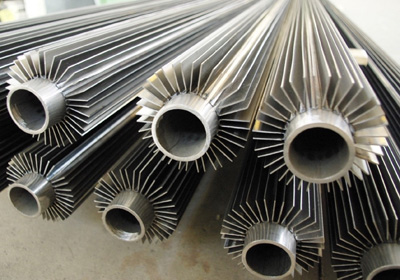
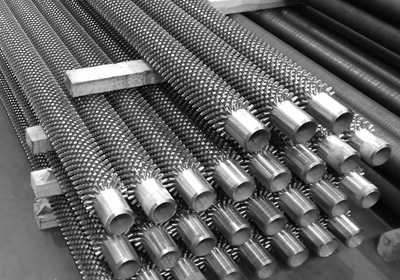
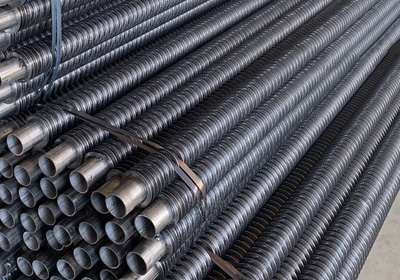
Finned tubes , simply put, are a type of heat transfer enhancement element . They consist of a base tube (usually a round tube) with many thin metal fins installed on its outer or inner wall through a series of processing techniques.
Core objective: It greatly increases the heat transfer area, achieving efficient heat exchange within a limited space and volume.
Classification method |
Main types |
Features |
Typical applications |
Processing technology |
Rolled finned tubes |
High efficiency, good strength, and low contact thermal resistance |
Air coolers, air conditioners, waste heat recovery |
High-frequency welded finned tubes |
High temperature and high pressure resistance, flexible material combination, and low contact thermal resistance |
Boiler, petrochemical, high-temperature flue gas recovery |
|
Tension-wound finned tube |
Low cost, but may be loose. |
Low-temperature air heater |
|
String-finned tubes |
Dense fins result in low cost but relatively high contact thermal resistance. |
Home air conditioners and heaters |
|
Cast finned tubes |
Corrosion resistant, wear resistant, heavy |
Chemical, metallurgical, and acid dew point corrosive environments |
|
Fin shape |
Spiral Ring |
Enhanced perturbation, the most widely used |
Most gas heat exchange applications |
Vertical |
Applicable to parallel flow |
Boiler economizer, air preheater |
|
plate-like |
Compact structure and extremely high efficiency |
Aerospace, petrochemical (plate-fin heat exchangers) |
|
Material |
Aluminum fins - carbon steel pipe |
High cost performance and widest application |
Air coolers, general heating/cooling |
Aluminum/copper fins - stainless steel tube |
Corrosion resistant and high strength |
Chemical industry, food industry, marine environment |
|
All stainless steel |
Excellent corrosion resistance, high cost |
Highly corrosive environment |
Ⅲ. Materials of Finned Tubes
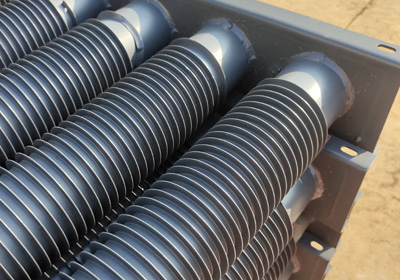
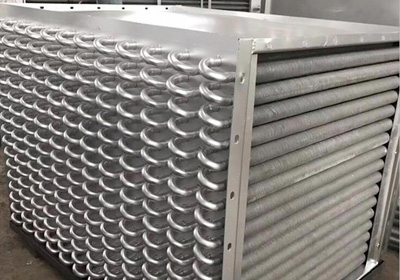
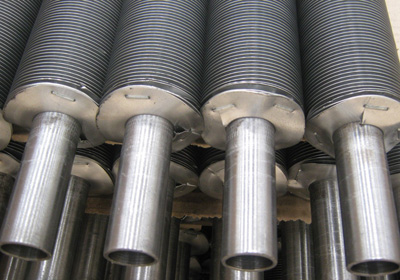
The choice of material depends on the operating temperature, pressure, corrosiveness of the medium, and cost.
|
Material |
Features |
use |
base tube |
carbon steel |
Most commonly used, low cost, good strength |
Non-corrosive media such as water, steam, and oil |
Stainless steel |
Corrosion resistant |
Chemical industry, food industry, marine environment, etc. |
|
Copper / copper-nickel alloy |
Excellent thermal conductivity and resistant to seawater corrosion |
Ships, high-end air conditioning |
|
alloy steel |
Used in high temperature and high pressure applications |
Power plant boiler |
|
fins |
aluminum |
Most commonly used, with good thermal conductivity, light weight, low cost, and easy to process. |
Operating temperature is typically ≤ 200°C |
copper |
It has better thermal conductivity than aluminum, but is heavier and more expensive. |
Special requirements |
|
Carbon steel / stainless steel |
High temperature resistance, good strength, and can be made of the same material as the base pipe (welded type). |
Applications with operating temperatures > 250°C |
IV. Dimensions of Finned Tubes
Finned tubes are available in a wide range of sizes and are typically custom-made to meet the design requirements of the heat exchanger. Here are some common ranges:
outer diameter of base tube |
Common sizes are Φ16mm, Φ19mm, Φ22mm, Φ25mm, Φ32mm, Φ38mm, Φ50mm , etc. |
Base pipe wall thickness |
The thickness depends on the pressure applied; common thicknesses are 1.5mm, 2.0mm, 2.5mm, and 3.0mm. |
Fin height |
Typically between 6mm and 20mm |
Fin thickness |
Aluminum fins are approximately 0.2mm to 0.5mm thick ; steel fins are approximately 0.8mm to 1.5mm thick. |
Fin spacing |
is typically 2.0mm, 2.3mm, 2.5mm, 3.0mm, 4.0mm , etc. The smaller the spacing, the larger the total heat transfer area, but the easier it is for dust to accumulate and cause blockages. |
Heat transfer area ratio (fin ratio): This is a key parameter, referring to the ratio of the total external surface area of the finned tube to the internal surface area of the bare tube. It typically reaches [value missing]. 10 to 25 times , or even higher.
Just like you, 70% customers choose long-term cooperation with BBN steel not only for our good product and service quality, good reputation in the international market, but also for our experienced one-stop raw material supply and further steel processing!
 Online Consultation